
A single weekend of instruction now stands as the primary legal gateway between a New York resident and their right to carry a concealed firearm. Under the Concealed Carry Improvement Act, the path to licensure requires a level of academic and technical proficiency that often causes significant anxiety for even the most experienced shooters. You likely recognize that the 16+2 hour mandate is more than a simple attendance requirement; it's a rigorous assessment of your understanding of the NYS concealed carry class curriculum and your ability to apply use-of-force laws in high-pressure scenarios.
This article provides a comprehensive breakdown of the mandatory training standards, ensuring you're fully prepared for the 80% passing threshold on the written exam and the specific live-fire qualification metrics. We'll clarify the division between the 16 hours of classroom instruction and the two hours of range time, including the exact marksmanship standards required for certification. By detailing each regulatory topic from sensitive locations to safe storage, we'll help you approach your NYSNRA101: Combined NYS 18-Hour Conceal Carry + NRA Basic Pistol Class with the confidence that comes from thorough preparation and legal clarity.
Key Takeaways
- Understand the specific legal requirements of the CCIA and the detailed modules that comprise the NYS concealed carry class curriculum to ensure full regulatory compliance.
- Identify the performance benchmarks for the mandatory two-hour live-fire qualification, including the specific target dimensions and accuracy ratios required by the state.
- Gain clarity on the administrative prerequisites and the written examination format, which requires a minimum score of 80% for successful course completion.
- Evaluate the procedural benefits of the NYSNRA101: Combined NYS 18-Hour Conceal Carry + NRA Basic Pistol Class, which integrates state mandates with internationally recognized safety certifications.
The Legal Framework: Why the NYS 16+2 Hour Training is Mandated
The Concealed Carry Improvement Act (CCIA), which took effect on September 1, 2022, established the current statutory requirements for firearm licensing across the state. This legislation was a direct response to the landmark NYSRPA v. Bruen decision, which transitioned New York to a "shall issue" permitting framework. To ensure a high level of public safety, the state replaced the old "proper cause" standard with a rigorous 18-hour training mandate. The New York State Division of Criminal Justice Services (DCJS) maintains strict oversight of the NYS concealed carry class curriculum to ensure every certified instructor delivers uniform, legally compliant education.
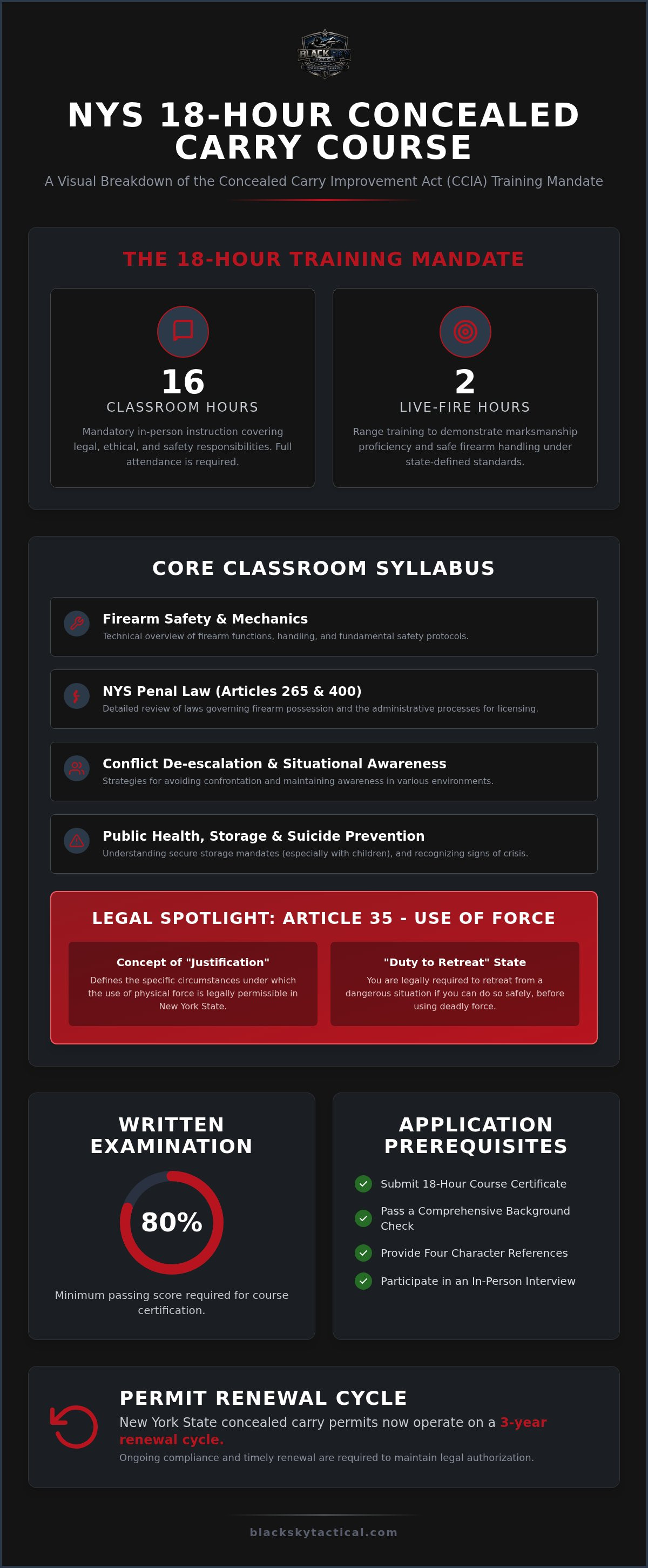
This mandate is structured into two specific parts: 16 hours of in-person classroom instruction and two hours of live-fire range training. All new applicants for a concealed carry license must complete this entire course before submitting their paperwork to county licensing officers. This requirement isn't just for new shooters. Residents in Westchester, Nassau, and Suffolk counties, as well as New York City, must also complete this training to renew their existing licenses.
The 2026 Standards for Permit Eligibility
Securing your 18-hour training certificate is a vital prerequisite, but it's only one component of the eligibility process. Applicants are required to undergo a comprehensive background check and provide four character references. You'll also likely participate in an in-person interview with a licensing official. The certificate you earn integrates directly with your county-level application package. Attendance rules are absolute. You can't skip modules or arrive late. Instructors are legally bound to verify full participation in every instructional block before they can issue your credentials.
Course Certification and Recertification Cycles
Your training certificate serves as proof of proficiency during your initial application. However, maintaining your permit requires ongoing compliance. New York now operates on a 3-year renewal cycle for concealed carry permits, a significant shift from previous decades. You'll need to keep track of your expiration date to ensure your training remains current under state law. If you're an existing permit holder, understanding the NYS CCW renewal training requirements is the only way to prevent a lapse in your legal authorization to carry. Stay diligent about these timelines.
Core Classroom Syllabus: The 16-Hour Instructional Mandate
The 16-hour classroom portion of the NYS concealed carry class curriculum is a structured deep dive into five distinct modules, each designed to address the legal and ethical responsibilities of firearm ownership. You'll begin with a technical overview of mechanical functions and safety protocols before transitioning into the complexities of Penal Law Articles 265 and 400. These sections cover the specifics of firearm possession and the administrative processes governing licensing. Instruction continues with conflict de-escalation strategies and the legal nuances of situational awareness. You'll also analyze the adverse effects of substance use on judgment and firearm handling. The final modules focus on public health and safety, specifically suicide prevention and the stringent secure storage standards mandated for all permit holders. For those seeking a professional environment to master these topics, the NYSNRA101 course provides the structured atmosphere necessary for such serious study.
The curriculum doesn't just list these topics; it requires a demonstrated understanding of how they intersect with daily life. For example, the secure storage module details your obligations when children or prohibited persons reside in your home. This level of detail is why the NYS concealed carry class curriculum is often delivered over a full weekend, ensuring you aren't just hearing the information, but absorbing the gravity of your new responsibilities.
Legal Instruction: Use of Force and Article 35
Article 35 of the New York State Penal Law serves as the bedrock of the curriculum's legal instruction. This module centers on the concept of "Justification," which dictates exactly when the use of physical force is permissible. You'll learn that New York is a "duty to retreat" state, meaning you're legally required to exhaust all safe avenues of escape before employing deadly physical force in public spaces. Deadly physical force is strictly defined as force that, under the circumstances in which it's used, is readily capable of causing death or other serious physical injury. Understanding these boundaries is essential to avoid criminal liability following a self-defense encounter.
Holster Considerations and Safe Carry Practices
Practical safety extends to how you carry your firearm daily. The curriculum emphasizes holster retention strategies to ensure your firearm remains secure during physical activity or attempted unauthorized access. You'll practice safe drawing and re-holstering techniques using inert training aids to build the muscle memory required for the range. These exercises are critical for preventing "negligent discharges" during the transition from concealment to engagement. For the live-fire qualification, you're required to use a holster that's specifically designed for your firearm and features a secure retention mechanism to prevent accidental discharge or loss.
The 2-Hour Live Fire Qualification: Proficiency Standards
The transition from the classroom to the live-fire range represents the most critical phase of the NYS concealed carry class curriculum. This two-hour session isn't merely a practice period; it's a formal proficiency assessment conducted under the strict supervision of a certified instructor. Every participant must undergo a comprehensive safety briefing and range orientation before any ammunition is handled. This protocol ensures that all shooters understand the specific range commands and emergency procedures unique to the facility. Instructors evaluate your ability to maintain muzzle discipline and proper trigger finger placement throughout the entire duration of the session, as these are the primary indicators of a responsible permit holder.
The actual course of fire is standardized to ensure uniform competency across the state. According to the DCJS standards for 2026, you're required to discharge five rounds at a target measuring 11 inches by 25.5 inches from a distance of four yards. To achieve a passing score, at least four of those five rounds must strike the target. While the distance is relatively short, the stress of a formal qualification often reveals deficiencies in basic marksmanship that weren't apparent during dry-fire practice. Success requires a steady application of the marksmanship principles covered during the 16-hour classroom mandate.
Required Gear for the Range Session
Preparation for the range requires specific equipment to meet safety and instructional standards. You must provide a firearm that's in good working order and compatible with the ammunition you've brought for the session. Eye and ear protection are mandatory; electronic hearing protection is often recommended to ensure you can clearly hear instructor commands over the noise of the range. As established in the NYS concealed carry class curriculum, your holster must provide adequate retention and completely cover the trigger guard to be permitted on the firing line. Instructors will inspect all gear prior to the commencement of live fire to ensure it meets these regulatory safety benchmarks.
Common Reasons for Qualification Failure
Failure to qualify usually stems from procedural safety errors rather than a lack of accuracy. Muzzle flagging, which occurs when a shooter unintentionally points their firearm at themselves or others, results in immediate disqualification from the course. Similarly, placing your finger inside the trigger guard before you're ready to fire is a violation of fundamental safety rules that instructors won't overlook. Instructors also monitor your ability to follow specific commands; failing to cease fire immediately upon a "cold range" call is grounds for failure. Finally, while the accuracy standard is attainable, failing to land the required four out of five rounds on the target will necessitate a retake of the qualification portion.
Preparation and Compliance: Navigating the Administrative Process
The administrative phase of the NYS concealed carry class curriculum begins long before you step onto the range. Enrollment requires the submission of specific documentation to ensure you meet the baseline legal criteria for training. You'll need to provide a valid New York State driver's license or non-driver identification card to verify your residency and identity. For those seeking to fulfill renewal requirements in Rockland or Orange counties, it's essential to have your current permit information available, as instructors must verify your status against local licensing records. This meticulous attention to detail ensures that your training certificate is issued with accurate data that aligns with the requirements of the county clerk's office.
The 16-hour classroom portion concludes with a mandatory written examination that serves as a final gatekeeper for certification. This test isn't a mere formality; it's a comprehensive assessment of your grasp of the NYS concealed carry class curriculum, specifically focusing on the high-stakes areas of use-of-force justification and the identification of sensitive locations. You're required to achieve a minimum passing score of 80% to demonstrate that you possess the legal knowledge necessary to carry a firearm responsibly. The exam format typically utilizes multiple-choice and true or false questions, which are designed to eliminate ambiguity and confirm your understanding of the Penal Law updates that took effect in 2022.
Upon successful completion of both the academic exam and the live-fire qualification, you'll be issued a formal Certificate of Completion. This document is a standardized DCJS form that licensing officers in Westchester and surrounding counties use as primary evidence of your compliance with state mandates. You should treat this certificate as a vital legal record, as it's the specific credential that allows your application to proceed through the final stages of the permit issuance process.
Study Tips for the 18-Hour Intensive
Successfully navigating the 18-hour intensive requires a disciplined approach to the material. You should focus your study efforts primarily on the "Justification" sections of Article 35, as this legal framework governs every potential defensive encounter you might face. Staying engaged during 16 hours of sedentary classroom instruction is often difficult; we recommend taking structured notes and actively participating in the de-escalation role-play exercises to reinforce the concepts. Reading the full text of NYS Penal Law Articles 265 and 400 before your first session will help you familiarize yourself with the technical terminology used by the instructors.
Post-Course Steps for Permit Issuance
Once you've secured your training certificate, you must submit it directly to your respective licensing authority as part of your application or renewal package. In Westchester, this process usually involves coordinating with the County Clerk’s office to update your file. The timeline for permit processing can vary significantly, often stretching several months based on the current volume of applications in counties like Westchester or even across the border for those monitoring Bergen county requirements. If you feel that you need to build your confidence before attending the mandatory sessions, you can pursue private firearm training for beginners NY to establish a solid foundation of safety and marksmanship. To ensure your paperwork is handled with professional precision, you can enroll in the NYSNRA101 course today and begin the certification process.
Beyond the Mandate: The NYSNRA101 Combined Approach
While the state-mandated training provides the legal groundwork for licensure, the NYSNRA101: Combined NYS 18-Hour Conceal Carry + NRA Basic Pistol Class was developed to address the practical skills that a purely regulatory syllabus might overlook. The NYS concealed carry class curriculum is heavily weighted toward administrative and legal compliance, which is essential for staying within the boundaries of the law. However, mechanical mastery and shooting fundamentals are equally vital for the responsible practitioner. By integrating the NRA curriculum, we bridge the gap between knowing the law and safely operating a firearm under stress. Our instructors possess deep familiarity with the specific expectations of permit offices in Rockland, Orange, and Westchester counties, ensuring that your certification is beyond reproach when it reaches a licensing officer's desk.
Professional instruction matters because the stakes of concealed carry are inherently high. We prioritize a sober, disciplined environment where every drill is linked to a practical outcome. This approach ensures that you don't just pass the 18-hour requirement but actually gain the confidence to carry a firearm in public safely. The dual-certification model provides a comprehensive education that satisfies both the state's mandate and the internationally recognized safety standards of the NRA. This combination is particularly beneficial for residents who seek a training experience that values technical precision as much as legal adherence.
The Advantages of the NRA Basic Pistol Integration
The NRA basic pistol shooting course provides a universal foundation of safety that is recognized across the country. Unlike the state-specific certificate, which is primarily a local administrative requirement, the NRA credential serves as proof of proficiency for out-of-state permit applications and range memberships nationwide. This integration builds a stronger foundation by focusing on grip, stance, and sight alignment in much greater detail than the NYS concealed carry class curriculum requires. It also opens doors to advanced training paths, allowing you to build on your skills long after the mandatory 18 hours are complete.
Enrollment for Local Residents
Finding a session that fits your schedule shouldn't be a hurdle to exercising your rights. We maintain a steady rotation of classes for residents of Rockland and Orange, ensuring that the training is accessible and relevant to your specific county procedures. For those who prefer a more controlled environment, we offer private group options for families or corporate teams. These sessions provide the same rigorous certification in a more personalized setting. To secure your seat in an upcoming session and fulfill your state requirements, you can Register for the NYSNRA101: Combined NYS 18-Hour Class today.
Securing Your Certification and Legal Peace of Mind
Navigating the 18-hour training mandate is a significant undertaking that requires dedicated focus on both administrative requirements and technical shooting standards. By thoroughly understanding the NYS concealed carry class curriculum, you've taken the first step toward fulfilling your legal obligations as a permit holder. Success in this process depends on your ability to internalize the complexities of New York's use-of-force laws and maintain absolute muzzle discipline during the live-fire qualification.
Our instructors are certified by the NRA and New York State to provide a comprehensive 18-hour syllabus that remains fully compliant with Rockland and Westchester county standards. This integrated approach ensures that your certification is recognized locally while establishing a foundation of safety that exceeds the state's minimum benchmarks. It's our responsibility to guide you through these rigorous mandates with clarity and professional integrity. We are committed to providing the instructional depth necessary for you to operate within the law.
Enroll in the NYSNRA101: Combined NYS 18-Hour Conceal Carry Course to begin your path toward responsible and lawful carry. We look forward to helping you secure your certification with confidence.
Frequently Asked Questions
How long is the NYS concealed carry certificate valid for?
The training certificate is generally valid for your initial permit application submission; however, once your permit is issued, you must adhere to the three-year renewal cycle. Residents in Westchester and Rockland counties should ensure their training is completed within a timeframe that aligns with their specific licensing office's processing windows. It's essential to maintain your records, as this certificate serves as the primary evidence of your proficiency under the CCIA mandates.
Do I need to own a handgun to take the NYS 18-hour course?
You don't need to own a handgun to enroll in the NYS 18-hour course, as New York law generally prohibits handgun possession without a valid permit. For new applicants, training is often conducted using firearms provided by the instructor under specific legal exemptions for instructional purposes. This allows residents in Orange and Westchester counties to complete the NYS concealed carry class curriculum and live-fire requirements before they are legally authorized to purchase their own firearm.
What happens if I fail the live-fire qualification portion?
If you fail to meet the proficiency standards during the live-fire qualification, you'll typically be required to undergo remedial training before attempting the assessment again. The state requires hitting the target with at least four out of five rounds from a distance of four yards. Safety violations, such as muzzle flagging or improper finger placement, result in an immediate failure. Instructors prioritize safety above all else to ensure every permit holder is a responsible practitioner.
Is the NYS CCW curriculum the same in every county?
The core NYS concealed carry class curriculum is standardized by the Division of Criminal Justice Services (DCJS) and remains consistent across all counties. While the 16+2 hour requirement is a statewide mandate, local licensing officers in Rockland or Orange County may have specific administrative procedures for how you submit your certificate. The instructional content regarding Penal Law Article 35 and sensitive locations is uniform to ensure every applicant receives the same legal foundation.
Can I take the 16 hours online and just do the 2 hours in person?
No, the 16-hour classroom portion must be completed through in-person instruction to satisfy the current New York State requirements. The DCJS standards emphasize the necessity of direct instructor interaction for complex topics like conflict de-escalation and use-of-force justification. Attempting to fulfill these hours through online platforms won't result in a valid certificate for your permit application in Westchester or Rockland counties. Physical attendance is mandatory for both the academic and range components.
Does the 18-hour course cover the requirements for the NJ Carry Permit?
The NYS 18-hour course is specifically designed to meet New York's statutory requirements and doesn't automatically fulfill the training mandates for a New Jersey Permit to Carry. New Jersey has its own specific CCARE protocols and qualification standards. For residents seeking dual licensure, we offer the NJSNRA101: Combined NJS Conceal Carry + NRA Basic Pistol Class, which is tailored to the distinct legal and proficiency requirements of the State of New Jersey.
What topics are covered in the NYS written exam?
The written examination covers the essential safety and legal modules of the 16-hour classroom instruction, including firearm mechanics, safe storage, and suicide prevention. A significant portion of the exam focuses on Penal Law Article 35 and the legal definitions of justification and deadly physical force. You must also demonstrate an understanding of sensitive and restricted locations. A minimum score of 80% is required to pass and move forward with the range qualification.
Are there any exemptions for the 18-hour training requirement?
Certain individuals, such as active or retired police officers and peace officers who've completed specific firearms training, may be exempt from the 18-hour requirement. These exemptions are determined by the specific criteria outlined in the CCIA and the rules of your local licensing authority. If you believe you qualify for an exemption in Rockland or Orange County, you should verify your status with the County Clerk’s office before assuming the training mandate doesn't apply to you.


