
The NJ PTC qualification is a formal administrative hurdle where technical errors in the holster draw are just as disqualifying as missed shots on the silhouette. For many applicants, the primary challenge isn't the shooting itself but the strict adherence to the Civilian Carry Assessment and Range Evaluation (CCARE) protocol. You're likely aware that the New Jersey State Police (NJSP) maintains a high threshold for proficiency, and the ambiguity surrounding the NJ PTC qualification course of fire often leads to unnecessary anxiety or failure on the range.
This guide provides a comprehensive breakdown of the 50-round test to ensure you approach your certification with absolute clarity. We'll examine each stage of the CCARE standard, including specific distances, required round counts, and the mandatory Use of Force classroom components (which are essential for legal compliance). By understanding the procedural expectations and scoring metrics before you step onto the firing line, you can replace uncertainty with the disciplined focus required to pass on your first attempt.
Key Takeaways
- Understand the regulatory transition to the Civilian Carry Assessment and Range Evaluation (CCARE) and how it standardizes carry permit requirements across New Jersey.
- Master the specific stages of the NJ PTC qualification course of fire, including the 50-round sequence and the 80% accuracy requirement on the FBI Q target.
- Ensure your equipment, including holster specifications and handgun registration, aligns with the strict administrative mandates set by the New Jersey State Police.
- Discover how structured practice and professional training can help you overcome the technical challenges of the holster draw before your formal evaluation.
Understanding the CCARE Protocol: NJ's Standardized Mandate
The Civilian Carry Assessment and Range Evaluation, commonly known as CCARE, represents the current regulatory standard for individuals seeking a Permit to Carry in New Jersey. Following a significant transition implemented by the New Jersey State Police in July 2023, this protocol replaced previous disparate standards to establish a uniform level of proficiency across all jurisdictions. The NJ PTC qualification course of fire is a comprehensive evaluation of an individual's ability to safely handle, draw, and discharge a firearm under specific time constraints. This mandate applies equally to new applicants and those seeking their biennial permit renewals, ensuring that every permit holder maintains a consistent baseline of tactical competence.
A critical component of this standardized mandate is the dual requirement of live-fire proficiency and classroom instruction regarding the NJ Use of Force laws. Unlike previous iterations of the permit process, an applicant cannot simply demonstrate marksmanship. They must also complete a formal educational block that covers the legal justifications for the use of deadly force, the duty to retreat, and the specific statutory limitations placed upon concealed carry in New Jersey. This integrated approach ensures that permit holders are not only physically capable of discharging a firearm but are also legally prepared for the administrative and judicial scrutiny that follows a self-defense encounter.
The Legal Framework of NJ PTC Training
The CCARE protocol operates under the direct oversight of the New Jersey Attorney General, who dictates the specific training requirements that instructors must validate. To begin this process, applicants must provide their State Bureau of Identification (SBI) number and a valid Firearms Purchaser Identification (FID) card. Certified instructors act as the state's agents in this capacity, bearing the professional responsibility to certify that an applicant has met every requirement of the NJ PTC qualification course of fire. This administrative verification is a prerequisite for the submission of the permit application through the NJSP online portal.
Assessment vs. Instruction: Setting Expectations
Applicants must recognize that the qualification session is a formal assessment of existing skills rather than a beginner's training course. The protocol requires participants to draw from a holster, a high-risk maneuver that demands significant prior experience. If an applicant arrives at the range without a mastered draw stroke, they risk immediate disqualification for safety violations. While poor marksmanship results in a simple failure to qualify, safety infractions such as "muzzling" or improper trigger finger discipline are treated with extreme gravity. For those who lack confidence in their holster transitions, pursuing private firearm training prior to the assessment is the most responsible path toward compliance.
The 50-Round Course of Fire: Stage-by-Stage Breakdown
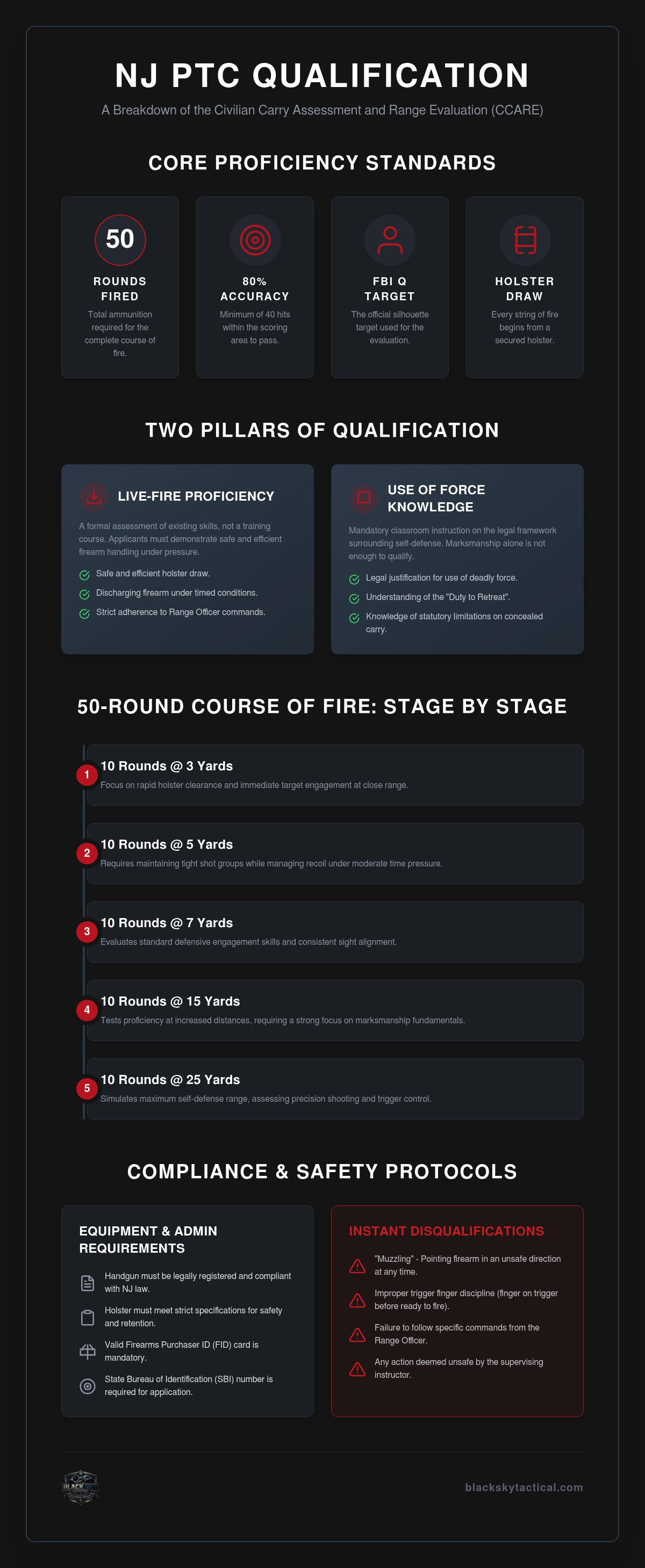
The NJ PTC qualification course of fire is structured as a 50-round ballistic assessment conducted on an FBI Q silhouette target. To achieve certification, an applicant must demonstrate an 80% proficiency rate, which equates to a minimum of 40 hits within the scoring area. This standard isn't merely a suggestion but a strict administrative threshold mandated by the New Jersey State Police to ensure public safety. Every string of fire begins from a secured holster, requiring the applicant to demonstrate a safe and efficient draw stroke under the direct supervision of a Range Officer. It's essential to realize that your performance is evaluated from the moment you approach the firing line, not just when the trigger is pulled.
The Range Officer (RO) utilizes specific procedural commands to maintain safety and structure throughout the evaluation. You'll be instructed to "load and make ready," followed by the specific requirements for each string of fire. Time limits are strictly enforced, and failure to follow commands or a violation of safety protocols, such as placing your finger on the trigger before the muzzle is oriented toward the target, results in immediate disqualification. Consistency is the primary factor in passing, as the cumulative nature of the test means a single poor stage can jeopardize your final score.
Distances and Round Counts
The course is divided into five distinct stages, each consisting of 10 rounds fired at varying distances to simulate a range of defensive scenarios. The progression is as follows:
- Stage 1 (3 Yards): This stage focuses on rapid holster clearance and immediate target engagement at close range.
- Stage 2 (5 Yards): Requires maintaining tight shot groups while managing recoil under moderate time pressure.
- Stage 3 (7 Yards): Evaluates proficiency at the industry-standard defensive distance where most encounters occur.
- Stage 4 (10 Yards): Tests fundamental marksmanship and sight alignment as the distance increases.
- Stage 5 (15 Yards): Serves as the final assessment of long-range handgun accuracy, often proving the most difficult for those without consistent practice.
Scoring and the FBI Q Target
Scoring for the CCARE protocol is binary: a round is either a "hit" or a "miss." For a shot to count toward the 40-hit requirement, it must strike within the border of the "bottle" shape on the FBI Q target silhouette. Peripheral hits that strike the paper but fall outside this specific border are recorded as misses. Applicants often fail not because of poor aim, but because of procedural errors or rushing shots during the 15-yard stage. If you find your accuracy degrading at these distances, engaging in private firearm training can help refine your trigger control before the official evaluation.
Equipment Requirements and Holster Standards
To successfully navigate the NJ PTC qualification course of fire, an applicant's equipment must meet both state regulatory standards and the specific safety requirements of the certifying range. The handgun used during the evaluation must be legally possessed and, according to current administrative practices, should be the specific firearm the applicant intends to carry for self-defense. This ensures that the proficiency demonstrated during the CCARE protocol directly translates to the equipment used in daily life. Using a "target" pistol with a lightened trigger or oversized sights for the qualification, while technically permissible in some contexts, may not fulfill the spirit of the state's proficiency mandate if that firearm is not your primary carry choice.
Holster selection is equally critical for both safety and procedural compliance. Standard "Inside the Waistband" (IWB) or "Outside the Waistband" (OWB) holsters are the accepted norm for the evaluation. Most instructors and ranges mandate a strong-side draw, where the holster is positioned on the hip of the dominant hand. This requirement exists to minimize the risk of "flagging" or pointing the muzzle at one's own body or bystanders during the draw stroke. You should ensure your holster provides adequate retention and allows for a one-handed re-holstering maneuver, as this is a common safety benchmark during the 50-round assessment.
Certain equipment remains prohibited or heavily restricted during the formal qualification process. Appendix carry (AIWB), shoulder holsters, and cross-draw configurations are frequently disallowed due to the inherent safety risks they pose on a crowded firing line. While these carry methods may be legal for daily use, they often violate the safety protocols of private ranges during a high-stakes evaluation. Additionally, applicants should bring at least two or three magazines to the range. This allows for smooth transitions between strings of fire and ensures that mechanical issues with a single magazine don't lead to an administrative disqualification.
Optics and Modifications
New Jersey standards generally permit the use of Red Dot Sights (RDS) and weapon-mounted lights, provided they are securely attached and functional. If you choose to use an optic, you must be prepared to demonstrate proficiency with that specific system. Compensated barrels and aftermarket trigger groups are also allowed, but they must not compromise the firearm's safety features. The core principle remains: the NJ PTC qualification course of fire is a test of your ability to manage the specific tool you will rely on in a violent encounter.
Ammunition and Safety Gear
Logistical preparation is the final step in equipment compliance. You must bring a minimum of 50 rounds of ammunition for the test itself, though bringing 100 rounds is highly recommended to account for potential practice rounds or malfunctions. Most ranges require factory-new ammunition and may have specific policies regarding "ball" versus hollow point rounds for range use. Personal protective equipment, including wrap-around eye protection and electronic ear protection, is mandatory. High-quality ear protection is particularly beneficial, as it allows you to clearly hear the Range Officer's commands over the sound of gunfire.
Preparing for Success: Practice and Proficiency
Proficiency in the NJ PTC qualification course of fire is not achieved through casual attendance at the range but through deliberate, structured preparation. Because the assessment requires a holster draw for every string of fire, muscle memory is the primary factor in determining success or failure. Applicants often underestimate the cumulative fatigue and mental pressure of the 50-round evaluation. To mitigate these risks, you should engage in diagnostic shooting sessions where you identify specific trigger control issues, such as anticipation or milking the grip, before they manifest during the formal test.
Dry fire practice remains the most effective method for refining the draw stroke without the distraction of recoil. By practicing in a safe, controlled environment with an unloaded firearm and no ammunition present, you can focus on the economy of motion required to meet the time limits of the 7-yard and 15-yard stages. Mental preparation is equally vital; managing qualification nerves involves visualizing the Range Officer's commands and maintaining a disciplined focus on the front sight rather than the total score. Consistency in your stance and grip will ensure that your performance remains stable throughout the entire 50-round sequence.
The 4-Step Draw Stroke
A safe and efficient draw is a foundational requirement for the CCARE protocol. Breaking the movement into four distinct phases allows you to identify and correct technical errors before they become safety violations:
- Step 1: Grip and Clear. Establish a full firing grip on the handgun while it's still in the holster and release any active retention mechanisms.
- Step 2: Draw and Rotate. Pull the firearm vertically to clear the holster and immediately rotate the muzzle toward the target.
- Step 3: Meet and Greet. Bring the support hand to the firearm at the center of the chest to establish a firm, two-handed grip.
- Step 4: Extend and Prep. Drive the firearm toward the target while simultaneously taking up the slack in the trigger and aligning the sights.
Common Pitfalls and How to Avoid Them
Technical failure often occurs during the 3-yard stage when applicants rush their shots, assuming the close proximity guarantees a hit. Even at this distance, fundamental accuracy is required to maintain the 80% passing threshold. Another common issue is poor recoil management during the 15-yard stage, where slapping the trigger causes rounds to fall outside the FBI Q bottle silhouette. Finally, safety infractions, such as moving the finger to the trigger before the muzzle is oriented toward the target, result in an immediate administrative termination of the session. If you're uncertain about your ability to perform these maneuvers safely, you should schedule Private Firearm Training to ensure your skills meet the state's rigorous standards before your evaluation date.
Black Sky Tactical: Your Bridge to NJ PTC Compliance
Black Sky Tactical functions as a disciplined institution that bridges the gap between individual applicants and the rigorous expectations of the New Jersey State Police. Our primary offering, the NJSNRA101: Combined NJS Conceal Carry + NRA Basic Pistol Class, is a comprehensive solution that integrates the mandatory 18-hour educational mandate with the practical skills required for the NJ PTC qualification course of fire. We provide expert coaching tailored specifically for residents of Bergen County and Rockland County, ensuring that every participant approaches the firing line with a thorough understanding of both tactical proficiency and the NJ Use of Force statutes. Our commitment to legal transparency ensures that you're not just shooting for a score, but preparing for the professional responsibility of carrying a firearm in public spaces.
Comprehensive Training for NJ and NY
Fulfilling the 18-hour requirement efficiently requires a structured environment where administrative accuracy is prioritized. We've found that the NRA Basic Pistol Shooting Course serves as the ideal foundation for this process, as it establishes the fundamental safety and marksmanship principles that the CCARE protocol evaluates. For applicants who are transitioning to holster use for the first time, our Private Firearm Training for beginners offers a personalized setting to refine your draw stroke and trigger mechanics. This pre-qualification preparation is essential for those who wish to avoid the common technical errors that lead to administrative failure on the range.
Next Steps: Booking Your Qualification
Scheduling your training session is the final logistical step in meeting the state's mandates. When you attend the NJSNRA101 class, you should arrive prepared with your legally possessed firearm, a compliant holster, and at least 100 rounds of ammunition to allow for both a practice buffer and the formal 50-round assessment. Our instructors will guide you through the procedural commands and scoring metrics of the NJ PTC qualification course of fire, providing real-time feedback to ensure your performance meets the 80% proficiency standard. We maintain a methodical pace to ensure every applicant absorbs the gravity of the legal requirements before certification is granted.
Take the necessary steps to ensure your certification is handled by professionals who prioritize compliance and safety. Register for the NJSNRA101 Combined Class today and secure your path toward a New Jersey Permit to Carry.
Achieving Proficiency and Compliance in New Jersey
Navigating the administrative and tactical requirements of the CCARE protocol demands a disciplined approach to both firearms handling and legal education. The NJ PTC qualification course of fire serves as a high-stakes evaluation where technical precision in the holster draw is just as vital as hitting the FBI Q silhouette. By standardizing these requirements, the state ensures that every permit holder maintains a verifiable level of competence and safety. Success on the range is the result of methodical preparation and a clear understanding of the procedural commands used during the evaluation.
Whether you're a new applicant or seeking a renewal, our NRA Certified Instructors provide the specialized multi-state training expertise necessary to ensure your 18-hour mandatory compliance is guaranteed. We focus on bridging the gap between basic marksmanship and the rigorous expectations of the New Jersey State Police. By prioritizing legal transparency and tactical skill, we prepare you for the serious responsibilities of carrying a firearm for self-defense. Secure Your Seat in the NJSNRA101 Combined Carry Course to finalize your certification with professional assurance. We look forward to helping you meet these standards on your first attempt.
Frequently Asked Questions
What is the passing score for the NJ PTC qualification?
The passing score for the NJ PTC qualification is 80%, which requires a minimum of 40 hits on the FBI Q target out of 50 rounds fired. These hits must be within the border of the silhouette to be counted as valid. Every shot is evaluated under specific time constraints across five distinct distances. This administrative threshold is strictly enforced, and instructors won't grant exceptions for scores that fall below this mark.
Can I use a subcompact handgun for the NJ CCARE test?
You may use a subcompact handgun for the CCARE test, provided the firearm is legally possessed and registered to you as required by state law. However, subcompact firearms often present greater challenges during the 15-yard stage of the NJ PTC qualification course of fire due to their shorter sight radius and increased recoil. It's recommended that you qualify with the specific handgun you intend to carry to ensure consistent tactical proficiency.
How often do I need to requalify for my NJ Permit to Carry?
Permit holders must requalify every two years as part of the biennial permit renewal process in New Jersey. This requirement ensures that individuals maintain their marksmanship and safety standards over time. Each renewal requires a fresh certification of the 50-round shooting assessment and the Use of Force classroom instruction. Failing to complete these steps within the required timeframe will result in the expiration of your legal authority to carry.
Is holster draw training included in the qualification session?
The qualification session is a formal evaluation of your existing skills and doesn't include basic holster draw instruction. Applicants are expected to arrive with a mastered draw stroke and established safety habits. If you lack experience drawing from a holster, you should seek private firearm training in Bergen County or Rockland County before attending the evaluation. Range officers will disqualify any participant who demonstrates unsafe handling or procedural ignorance during the draw.
What happens if I fail the shooting portion of the NJ PTC?
If you fail the shooting portion, you'll be required to schedule a remedial session and attempt the evaluation again at a later date. While a failure based on score is an administrative hurdle, a failure based on a safety violation is treated with significantly more gravity. Individuals from Orange County or Westchester County who demonstrate unsafe handling may be required to complete additional supervised training before an instructor permits a second qualification attempt.
Do I need to take the NJ Use of Force class if I already have a permit?
Yes, the NJ Use of Force classroom instruction is a mandatory requirement for all permit applicants, including those who previously held a permit under older standards. The CCARE protocol integrated this legal block to ensure every permit holder understands current statutes regarding deadly force and the duty to retreat. Completing this training is a prerequisite for the instructor to sign off on your proficiency certification for the New Jersey State Police.
Are Red Dot Sights allowed during the NJ PTC course of fire?
Red Dot Sights are fully permitted during the NJ PTC qualification course of fire, provided the optic is securely mounted and the applicant is proficient in its use. Utilizing an RDS can assist with accuracy during the challenging 10-yard and 15-yard stages of the assessment. You must be prepared to manage the electronic system under the same time constraints as those using iron sights, ensuring your equipment meets all range safety standards.
Can I qualify for NJ if I am a New York resident?
New York residents are eligible to apply for a New Jersey Permit to Carry as non-residents. Applicants from Rockland County or Westchester County must complete the same training mandate and shooting qualification as NJ residents. Black Sky Tactical provides specialized training that allows NY residents to fulfill these requirements efficiently. Once certified, non-residents submit their applications through the New Jersey State Police online portal for jurisdictional processing and final approval.


