
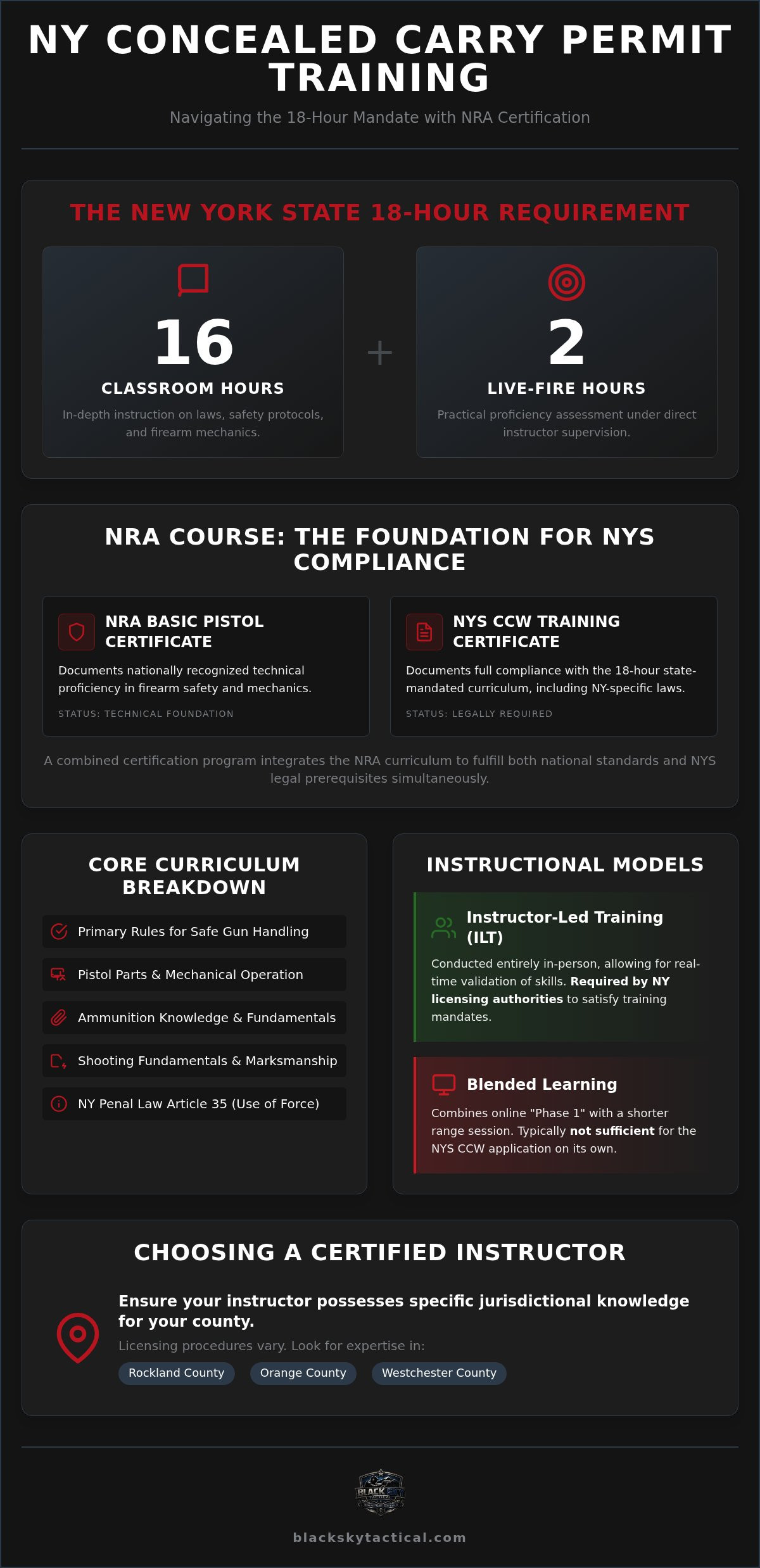
What if the primary obstacle to your New York concealed carry permit isn't the background check, but a misunderstanding of how specific training certifications interact with state law? Obtaining a permit is a rigorous administrative process where a single oversight in your training credentials can lead to an immediate application denial. It's common to feel overwhelmed by the 18-hour training mandate, which includes 16 hours of classroom instruction and two hours of live-fire proficiency. Selecting an NRA basic pistol course NY that's properly integrated into this mandated curriculum is the most reliable method to ensure your certification is accepted by licensing officers in Rockland, Orange, or Westchester counties.
We recognize the gravity of these requirements and the concern that a non-compliant course could jeopardize your application. This guide provides a detailed overview of how the NRA curriculum serves as the structural foundation for the mandatory CCW certification, ensuring you build shooting fundamentals while meeting every administrative prerequisite. We'll outline the components of the 16+2 hour requirement, the standards for the live-fire assessment, and the legal obligations that define responsible permit ownership. This professional briefing provides the clarity you need to move forward with confidence in your compliance.
Key Takeaways
- Understand how the NRA basic pistol course NY functions as the technical foundation for the 18-hour New York State concealed carry training mandate.
- Master essential firearms safety protocols and the mechanical operations of revolvers and semi-automatic pistols to establish a professional standard of safe handling.
- Learn the specific administrative requirements for the 16-hour classroom and 2-hour live-fire components necessary for a valid CCW application.
- Identify the criteria for selecting certified instructors who possess the necessary jurisdictional knowledge for Rockland, Orange, and Westchester county licensing procedures.
- Discover how a combined certification program streamlines your path to compliance by providing both national and state-recognized credentials in a single syllabus.
Defining the NRA Basic Pistol Course in the New York Regulatory Landscape
The National Rifle Association established the Basics of Pistol Shooting as a standardized curriculum to ensure law-abiding citizens possess the requisite knowledge to handle firearms safely. In the context of New York's rigorous licensing environment, the NRA basic pistol course NY functions as the technical backbone for state-mandated safety training. It's designed to transition students from a state of zero experience to a verifiable baseline of safe, proficient handgun operation. The course is the national benchmark for firearm safety and mechanical proficiency as of 2026.
Instructor-Led vs. Blended Learning Formats
The NRA offers two primary instructional pathways: the Blended Learning model and the Instructor-Led Training (ILT) model. The Blended model requires students to complete an online component known as "Phase 1" before attending a range session. Conversely, the ILT version is conducted entirely in person, facilitating direct, continuous oversight by a certified professional. New York licensing authorities, particularly those in Rockland, Orange, and Westchester counties, typically require the Instructor-Led version to satisfy local training mandates. This preference exists because the in-person format allows the instructor to validate student proficiency in real-time. The instructor's role isn't merely to provide information; they serve as a certifying authority who confirms that the student can execute safe handling procedures under direct supervision during the range sessions.
National Standards vs. New York State Mandates
While the NRA curriculum provides a robust technical foundation, it must be distinguished from the specific mandates of the New York State Concealed Carry Improvement Act (CCIA). The NRA curriculum aligns with many safety requirements of the CCIA, but the state requires a broader 18-hour syllabus. This includes 16 hours of classroom instruction and two hours of live-fire training, covering legal topics such as New York Penal Law Article 35. An NRA certificate carries significant administrative weight during the permit application process because it proves the applicant has mastered firearms mechanics. However, it's not a direct substitute for the NYS CCW Training Certificate. Programs like the NYSNRA101 combined certification bridge this gap by fulfilling both requirements simultaneously.
- NRA Certificate: Documents technical proficiency and safety knowledge recognized nationally.
- NYS CCW Training Certificate: Documents compliance with the 18-hour state training mandate required by licensing officers.
Understanding these distinctions is vital for any applicant. Obtaining both certifications through a combined course ensures that your training meets the highest national standards while remaining fully compliant with New York's specific jurisdictional requirements.
The Core Curriculum: Mastering Firearms Safety and Mechanics
The technical instruction within an NRA basic pistol course NY begins with the three primary rules for safe gun handling, which serve as the non-negotiable foundation for all subsequent training. Students are taught to always keep the firearm pointed in a safe direction, to keep their finger off the trigger until they're ready to shoot, and to keep the gun unloaded until it's ready for use. These rules aren't merely suggestions; they're administrative requirements that instructors strictly enforce during every classroom and range session. The NYS 18-Hour Requirement necessitates this deep dive into safety protocols before any live-fire exercises commence to ensure applicant readiness.
Instruction continues with a detailed examination of pistol parts and their mechanical operations, distinguishing between the functions of revolvers and semi-automatic pistols. Students learn the nomenclature of frames, barrels, and actions, as well as the specific cycling processes that define different handgun types. This mechanical understanding extends to ammunition, where the syllabus covers the four components of a cartridge: the case, primer, powder, and bullet. Mastery of these mechanics is essential for identifying and clearing malfunctions, or stoppages, such as failures to fire or failures to extract. The 2026 syllabus prioritizes the mastery of specific shooting fundamentals, which include grip, stance, sight alignment, trigger control, and breath control, as the essential components for achieving technical proficiency.
The Five Fundamentals of Pistol Shooting
Developing a consistent shooting platform is the first step toward accuracy and effective recoil management. Students learn to establish a stance that provides balance and a grip that maximizes control over the firearm's movement. Sight alignment, the relationship between the front and rear sights, and sight picture, the placement of aligned sights on the target, are taught as scientific constants for defensive applications. Finally, mastering the trigger press is emphasized to ensure the student doesn't disturb the muzzle's orientation during the shot sequence. For those seeking professional oversight while learning these technical skills, engaging in private firearm training provides the individualized attention necessary for rapid skill acquisition.
Safe Storage and Home Defense Considerations
The curriculum outlines administrative protocols for unloading and securing firearms within a residential environment to prevent unauthorized access. This instruction aligns with the NY Safe Storage Act, which mandates specific storage conditions when children or prohibited persons are present in the home. It's vital to understand how these state laws interact with national standards to maintain total legal compliance. For younger family members, reviewing firearm laws for young adults NY can provide necessary context regarding age-specific restrictions and safety obligations under current New York statutes.
The NYS 18-Hour Requirement: Where the NRA Course Fits In
New York's licensing landscape demands a rigorous commitment to training. Under the provisions of New York Penal Law § 400.00, applicants must navigate a specific 18-hour training mandate that often causes confusion regarding its components. A common misconception is that a standalone 8-hour NRA basic pistol course NY is sufficient for permit issuance. It isn't. While the NRA curriculum offers the technical skeletal structure for safe operation, it must be augmented with specific state-required modules to reach the full 16 hours of classroom time and 2 hours of range proficiency. Integrating these curricula allows for a more cohesive educational experience, ensuring no administrative requirement is overlooked.
The '16+2' Syllabus Breakdown
The 18-hour syllabus is structured to provide a professional briefing on the high-stakes responsibilities of carrying a concealed firearm. The '16+2' format refers to the 16 hours of classroom theory followed by 2 hours of practical application. Within this timeframe, instructors cover conflict de-escalation, sensitive location restrictions, and the legal nuances of New York Penal Law Article 35. The NRA basic pistol course NY modules are embedded within this framework to provide the technical safety training required by both the NRA and the NYS DCJS. This approach ensures that students don't just learn to shoot, but learn the legal parameters governing their actions. Our Comprehensive Guide to the NY 18-Hour Concealed Carry Course (2026) details how these hours are allocated across the training schedule.
Live Fire Qualification Standards
The live-fire assessment is a formal evaluation of a student's ability to apply classroom theory under range conditions. The 2026 qualification standards require applicants to engage a target at multiple distances, ensuring they can maintain accuracy under the supervision of a certified instructor. A passing grade requires a score of at least 80% on the written portion and a successful demonstration of safe firearm manipulation during the course of fire. Nervousness is common, but it's manageable through the methodical application of the fundamentals taught earlier in the program. Instructors prioritize safety over speed, focusing on the administrative requirements that licensing officers in Rockland, Orange, and Westchester counties review before approving a permit application.
Choosing an Instructor in Rockland, Orange, and Westchester Counties
Selecting an instructor for an NRA basic pistol course NY requires due diligence that extends beyond a simple search for the lowest price or most convenient location. In the Hudson Valley, your training certificate must survive the scrutiny of county licensing officers who are intimately familiar with state-mandated standards. Verifying credentials through official NRA registries and local law enforcement lists is the first administrative step. You should prioritize instructors who demonstrate a transparent understanding of the 18-hour procedural mandate. Beware of "diploma mills" that attempt to condense the 16 hours of classroom instruction and 2 hours of live-fire training into a single day. Such practices don't satisfy New York's legal requirements and can lead to the immediate rejection of your permit application.
Logistical considerations also play a significant role in the quality of your education. Inquire about class sizes, as overpopulated sessions often result in diminished individual oversight during the critical range portion. Additionally, confirm that the training facility has a dedicated range for the live-fire qualification. If an instructor lacks a formal range agreement, they cannot legally conduct the practical assessment required for your certification. To ensure your training meets these rigorous standards, you can register for a certified NYSNRA101 course that aligns with all current state and local protocols.
Local Compliance and County Clerk Procedures
Jurisdictional knowledge is a vital attribute for any authorized trainer. The Rockland County Clerk's office, for example, may have specific procedural expectations that differ from the administrative timelines found in Orange or Westchester counties. Westchester County often has distinct requirements for the sequence of fingerprinting and training completion. It's imperative to ensure your training certificate is signed by an instructor authorized by the New York State Police and the DCJS. Consulting a Professional Private Firearms Instructor in NY ensures your certification carries the necessary legal weight for your specific county of residence.
What to Bring to Your NRA/NY CCW Class
Preparation is essential for a successful 18-hour program. Students must arrive with the necessary administrative documents, including a valid photo ID and any pre-course questionnaires required by the training facility. While some instructors provide the necessary firearms and ammunition for the live-fire qualification to ensure mechanical consistency, you must confirm this in advance. Standard required gear includes:
- Wrap-around eye protection and electronic or passive ear protection.
- Appropriate range attire, such as closed-toe shoes and high-neck shirts to prevent contact with hot brass.
- Note-taking materials to document legal definitions and safety protocols during the 16-hour classroom portion.
Arriving prepared allows you to focus on the technical and legal complexities of the curriculum rather than logistical oversights. This disciplined approach reflects the professional responsibility expected of every concealed carry permit holder in New York.
Black Sky Tactical: NYSNRA101 Combined Certification
Black Sky Tactical provides a structured, multi-disciplinary approach to firearm certification through the NYSNRA101: Combined NYS 18-Hour Conceal Carry + NRA Basic Pistol Class. This curriculum is meticulously engineered to exceed the baseline administrative requirements of the New York State Concealed Carry Improvement Act (CCIA) while instilling the rigorous technical standards of the National Rifle Association. By integrating the NRA basic pistol course NY into the mandatory 18-hour syllabus, we provide a cohesive educational experience that prepares residents of Rockland, Orange, and Westchester counties for the profound responsibility associated with carrying a concealed handgun. Our commitment to professional sobriety and legal precision ensures that every student departs with a thorough understanding of their obligations under the law.
Why a Combined Course is the Efficient Choice
Opting for a combined certification program is a strategic decision for applicants who value both time management and instructional consistency. Earning two distinct certificates within a single 18-hour program ensures that your training is recognized both at the state level for permit compliance and nationally as a testament to your technical foundation. The NRA Basic Pistol Shooting Course: The Foundation of Handgun Safety serves as the technical core of this instruction, allowing students to master mechanics before advancing to the legal and tactical complexities of the New York State CCW modules. This unified approach eliminates the instructional gaps that often occur when students piece together training from disparate sources, providing a singular, authoritative voice throughout the entire 16 hours of classroom work and 2 hours of range time.
Expert Guidance for the Permit Application
The administrative burden of a New York pistol permit application is significant, often requiring meticulous attention to local county-specific procedures that vary by jurisdiction. Our instructors function as disciplined experts, assisting students in understanding the specific application steps required by the Rockland and Orange county clerk's offices. This support extends beyond the initial 18-hour mandate, as we emphasize that tactical proficiency is a perishable skill that requires ongoing dedication. We view the completion of the NYSNRA101 course as the beginning of a professional relationship based on safety and meticulous skill-building. Students have the opportunity to transition from basic proficiency to private tactical instruction, ensuring their skills remain sharp and their adherence to the law remains absolute. To secure your placement in our next session and begin this methodical process, you may Register for the NYSNRA101 Combined Course to ensure your training meets the highest standards of professional responsibility.
Securing Your Path to Lawful Concealed Carry
Obtaining a concealed carry permit in New York is a multi-step administrative process that requires meticulous attention to both technical proficiency and legal compliance. As we've outlined, the NRA basic pistol course NY serves as the indispensable technical foundation upon which the state's 18-hour training mandate is constructed. By integrating national safety standards with the specific legal requirements of New York State, you'll ensure that your certification meets the scrutiny of licensing officers in Rockland, Orange, and Westchester counties. Choosing a curriculum that is both NYS DCJS-compliant and taught by NRA-certified instructors is the most efficient method to fulfill your professional obligations as a prospective permit holder.
Our instructors are prepared to guide you through the complexities of the 16+2 hour syllabus, providing the expert oversight necessary to master the fundamentals of safe handgun operation. We invite you to enroll in the NYSNRA101: Combined NYS 18-Hour & NRA Basic Pistol Class to begin your journey toward responsible firearm ownership. Taking this disciplined step ensures you're fully prepared for the gravity of concealed carry while maintaining strict adherence to the law. We look forward to assisting you in achieving your certification goals with clarity and professional precision.
Frequently Asked Questions
Is the NRA Basic Pistol course required for a New York pistol permit?
The NRA curriculum isn't explicitly named as a standalone requirement in state statutes, but it provides the technical safety components for the mandatory 18-hour CCW course. An NRA certificate alone is insufficient for a permit application. It must be integrated into a broader syllabus that includes 16 hours of classroom instruction and 2 hours of live-fire training as mandated by the New York State Police and DCJS.
How long is the NRA Basic Pistol course in NY compared to the CCW course?
A standard NRA Basic Pistol course typically requires 8 hours of instruction. In contrast, the New York State CCW mandate is significantly more rigorous, requiring a total of 18 hours. When these programs are combined, the NRA curriculum serves as the foundational technical day. This is followed by additional hours dedicated to New York penal law, de-escalation techniques, and the required live-fire proficiency assessment.
Can I take the NRA course online and still get my NY CCW permit?
No, New York State law requires that the 18-hour training mandate be completed through in-person instruction. While the NRA offers a blended learning model with an online "Phase 1" component, licensing officers in Rockland, Orange, and Westchester counties do not accept online training for permit issuance. Applicants must attend an instructor-led course to ensure all classroom and range hours are verified by a certified professional.
What is the passing score for the NYS concealed carry live-fire qualification?
Applicants must achieve a minimum score of 80% on the written examination to successfully complete the 18-hour course. For the live-fire qualification, students must demonstrate safe firearm manipulation and achieve passing accuracy at specified distances under instructor supervision. Failure to meet these proficiency standards prevents the issuance of the training certificate required by the licensing officer for your concealed carry permit application.
Do I need to own a gun before taking the NRA Basic Pistol course?
You don't need to own a handgun to participate in this training. In fact, New York law generally prohibits the possession of a handgun without a valid permit. Authorized instructors typically provide the necessary firearms and ammunition for the 2-hour live-fire portion of the course. This allows students to complete their legal training requirements safely and in full compliance with state handgun possession laws.
How much does the 18-hour NYS CCW and NRA combined course cost?
Fees for the 18-hour combined training vary across the state based on the provider and regional range costs. Industry observations in 2026 indicate that courses in the New York area often range between $280 and $300. These fees generally include classroom materials, range access, and the administrative processing of your certifications. Applicants should verify exactly what equipment is included in the fee before registering with an instructor.
Will an NRA certificate from another state be accepted in New York?
An NRA certificate obtained in another state is generally not accepted as a substitute for the NRA basic pistol course NY mandate. New York requires a specific 18-hour syllabus that includes localized instruction on New York Penal Law Article 35 and sensitive location restrictions. Out-of-state courses lack these mandatory legal modules, meaning they don't satisfy the administrative requirements set by New York State licensing authorities.
How often do I need to renew my NYS firearm safety training?
Recertification requirements are determined by individual jurisdictions within New York. Some regions, including Westchester County, require the completion of the 18-hour training course for pistol permit renewals to ensure continued legal and technical proficiency. Permit holders should consult with their local county clerk or licensing officer to determine the specific renewal intervals and training mandates applicable to their current place of residence.


