
A gun safety course for teens can support a family’s prevention plan, but it can’t replace secure storage or attentive adult supervision. Parents are right to ask what a course actually covers, especially when safety education can be confused with shooting instruction or permit training.
Responsible education should help teens recognize potential danger, avoid handling a firearm they encounter, and involve a trusted adult. It should also fit the teen’s maturity and the family’s circumstances, while reinforcing that adults remain responsible for preventing unauthorized access at home and elsewhere.
This guide explains which prevention topics to prioritize, how to compare course formats, and how to distinguish youth safety education from training intended for shooting skills or concealed-carry requirements. It also considers how families in New York and New Jersey can begin, where state rules differ and current requirements should be verified through official sources. Black Sky Tactical offers a Youth Safety Course as a structured training option; its role is to support, not replace, family supervision, secure storage, or compliance with applicable law.
Key Takeaways
- A gun safety course for teens should support prevention and responsible decision-making, not be mistaken for permit or shooting training.
- Compare course formats by their learning goals, setting, and how adults are involved.
- Use a family checklist to set boundaries, review secure storage, identify trusted adults, and revisit safety expectations.
- New York and New Jersey have different firearm rules, so check current official guidance for the state where your family lives.
- Black Sky Tactical’s Youth Safety Course offers a structured training option to consider alongside ongoing family supervision and secure storage.
Why a Gun Safety Course for Teens Starts With Prevention
A teen firearm-safety course should begin with preventing access and reducing risk, not with treating firearm use as an expected next step. Its purpose is to help young people recognize a potentially unsafe situation, understand boundaries set by responsible adults, and choose a safe response, including seeking help rather than approaching or handling a firearm.
Prevention-focused firearm education teaches teens to recognize risk, respect adult-set boundaries, and seek help; it does not prepare them to handle firearms independently. This distinction gives families a practical way to evaluate a gun safety course for teens: the central question is whether learning supports safer decisions, not whether it encourages access.
What a prevention-first course is, and is not
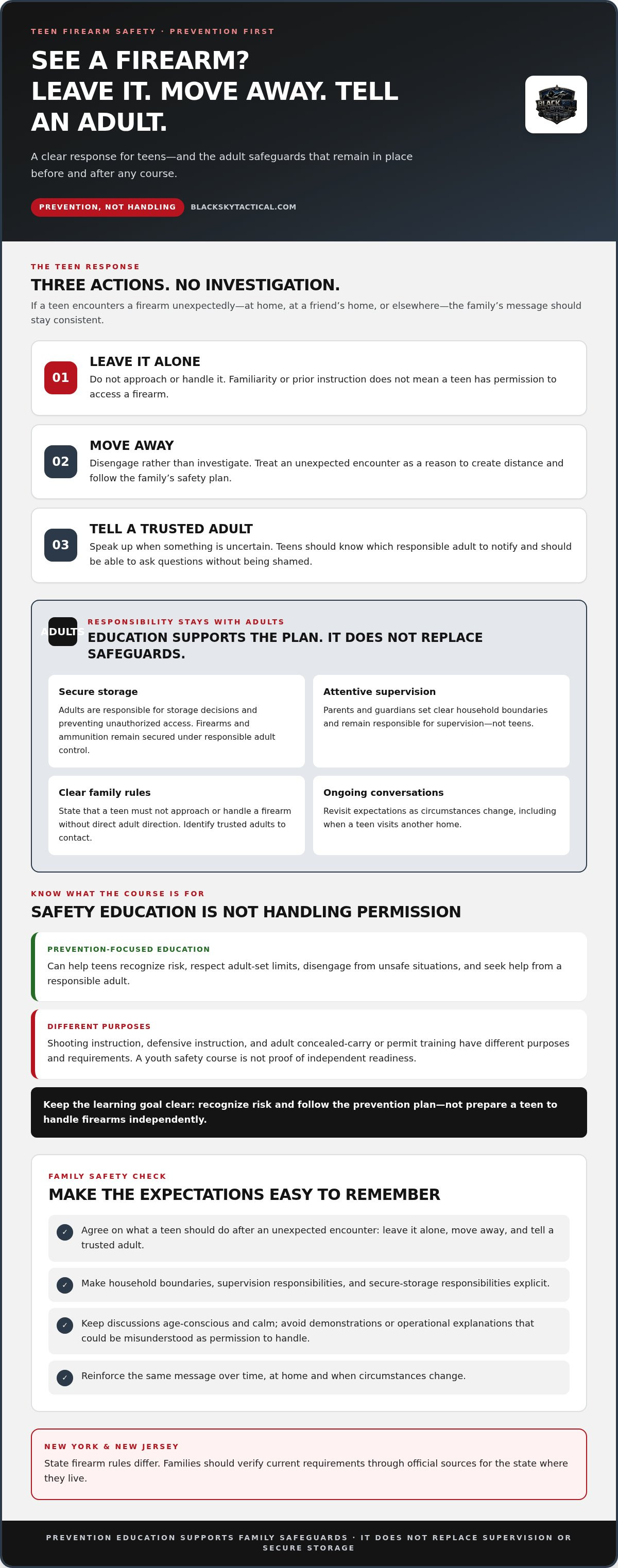
Prevention-first education can address awareness, communication, and responsible choices in situations a teen might encounter at home or elsewhere. For example, a family can reinforce that if a teen sees a firearm, the safe response is to leave it alone, move away, and tell a trusted adult. A general overview of the principles of gun safety can provide context, but household boundaries and adult supervision remain essential.
This education is not the same as shooting instruction, defensive instruction, or adult concealed-carry and permit training, which have different purposes and requirements. A course should not be treated as permission for a teen to handle a firearm or as proof of independent readiness. Families should keep the learning objective clear: recognize risk and follow a prevention plan.
Why parents and guardians remain part of the safety plan
Teens need consistent expectations beyond a classroom. Parents and guardians can explain household rules in calm, age-conscious language, invite questions, and make clear which adults a teen should approach for help. These conversations should build awareness without suggesting that firearm access is normal or that a young person is responsible for managing an adult’s firearm.
Adult responsibility continues after any course ends. Supervision, secure storage, and compliance with applicable law are separate safeguards; education does not replace them. Families can make their expectations explicit by agreeing on a few straightforward practices:
- State clearly that a teen must not approach or handle a firearm without direct adult direction.
- Identify trusted adults the teen can notify if they encounter a firearm.
- Review who is responsible for supervision and secure storage in the household.
- Revisit the family plan as circumstances change, including when the teen visits another home.
These conversations work best as ongoing guidance rather than a one-time warning. A teen should be able to ask questions without being shamed, while adults maintain clear limits and take responsibility for access prevention. A structured youth safety course can reinforce that approach, but the family’s consistent rules and safeguards form the day-to-day plan.
What Teens Can Learn From Structured Firearm-Safety Education
Once a family has established that prevention is the priority, structured education can give teens a shared framework for recognizing risk and responding consistently. The focus is not on memorizing technical details; it is on noticing when a situation falls outside the family’s boundaries, disengaging, and involving a responsible adult. These concepts are most useful when they are stated plainly and reinforced in everyday conversations.
A prevention-focused program may help families explore three connected themes: recognizing a potentially unsafe situation, following adult-set limits, and knowing whom to tell when something feels uncertain. A teen who encounters a firearm unexpectedly should not approach or handle it. The family expectation can be simple: move away and alert a trusted adult. That message should remain consistent whether the situation occurs at home, at a friend’s home, or elsewhere.
- Recognize risk: Treat an unexpected firearm encounter as a reason to disengage, not investigate.
- Respect boundaries: Follow the household’s rules and adult direction without assuming that familiarity or prior instruction grants access.
- Seek help: Know which trusted adult to notify, and speak up when circumstances are unclear.
Secure storage and ammunition awareness can also be discussed at a high level. Teens should understand that firearms and ammunition are to remain secured under responsible adult control, rather than being left for a young person to manage. Keep the discussion age-appropriate and avoid demonstrations or operational explanations that could be misinterpreted as permission to handle either. Adults, not teens, are responsible for storage decisions and supervision.
Instruction gives teens a framework for making safer decisions, while adult supervision and secure storage reduce access and reinforce that framework at home. Neither a class nor a family conversation replaces the other. Repetition matters because a single safety message may not come to mind in an unfamiliar or stressful situation. Consistent wording from caregivers makes the expected response easier to recall.
Before instruction, parents can explain the household’s boundaries and invite questions; afterward, they can ask the teen to describe the family’s agreed response in their own words. Keep the exchange calm and practical, correcting misunderstandings without making firearm access seem routine. Adults should also model consistent language and ensure household practices match what they tell the teen. For additional storage-focused follow-through, consult this family firearm safety and home storage guide.
A gun safety course for teens can be one structured part of this ongoing practice. Black Sky Tactical offers a Youth Safety Course for families considering firearm-safety education; its role is to support family prevention efforts, not replace supervision, secure storage, or compliance with applicable law.
How to Compare Teen Gun Safety Course Formats and Goals
Course format matters because it affects how a teen receives information, asks questions, and connects learning to family expectations. A classroom discussion, online materials, and a supervised practical setting can serve different purposes, but format alone doesn’t establish whether a course is suitable. Start with the stated learning goal: for a prevention-focused course, it should align with awareness, boundaries, and responsible decision-making rather than imply that participation qualifies a teen for independent firearm access.
More hands-on activity isn’t automatically a better fit for every teen. Maturity, attention, comfort speaking in a group, and the family’s immediate safety concerns are all relevant. Practical instruction, if included, should have clearly defined adult and instructor oversight; it should not be assumed to replace prevention education or household safeguards.
Classroom learning, online materials, and supervised settings
Classroom learning can provide a shared setting for discussion, while online materials may allow a family to review information at a flexible pace. A supervised practical setting differs in its environment and level of direct interaction. These are general format distinctions, not descriptions of any particular provider’s course. Families should consider which setting best supports the teen’s ability to understand the message and raise questions.
Online content can reinforce learning, but it can’t establish family rules, provide adult supervision, or secure firearms and ammunition. Likewise, a practical setting should never be treated as permission to handle a firearm outside the boundaries set by responsible adults and applicable law.
| Format | Learning goal | Adult involvement | Setting | Family question |
|---|---|---|---|---|
| Classroom-based | Build shared understanding through instruction and discussion | Clarify how adults support learning and follow-up | Group or instructional environment | Will the teen have a comfortable opportunity to ask safety questions? |
| Online materials | Review information at an individual pace | Discuss the material together and reinforce household expectations | Remote or home-based learning | How will we connect the material to our family’s safety plan? |
| Supervised practical setting | Learn in a more directly supervised environment | Understand who provides oversight and how boundaries are maintained | In-person setting, potentially including a range | Is direct adult and instructor oversight clearly part of the setting? |
Questions that help families assess course fit
Before choosing a format, consider whether the teen can stay engaged, follow instructions, and ask questions when something is unclear. A quieter teen may prefer a setting that allows time to reflect, while another may learn best through guided discussion. These are considerations for matching the learning environment to the young person, not measures of readiness to handle firearms.
Next, compare the course’s stated purpose with your family’s prevention priorities. Does it emphasize recognizing risk and making responsible decisions? Is the distinction between youth safety education and permit or shooting instruction clear? Can adults reinforce the learning afterward through consistent expectations at home?
For more context as you evaluate youth instruction, review this youth firearm safety training overview. Black Sky Tactical offers a Youth Safety Course; families can consider it within a prevention-first plan that continues to rely on adult supervision and secure storage.
A Parent’s Checklist for Teen Firearm Safety in NY and NJ
A family safety plan should be specific enough that each person understands the boundaries, knows who is responsible for firearm security, and can identify a trusted adult to contact with a concern. A gun safety course for teens can support that plan, but it doesn’t determine a teen’s legal eligibility to possess, use, or access a firearm. Requirements depend on jurisdiction and circumstances, so treat training and legal compliance as separate matters.
Use this sequence to establish and maintain household expectations:
- Discuss boundaries: State clearly that a teen must not access a firearm without adult authorization, and explain whom to tell if they encounter one unexpectedly.
- Review secure storage: Identify which responsible adult oversees storage and how the household prevents unauthorized access. Keep ammunition security within the same adult-led conversation.
- Name trusted adults: Make sure the teen knows whom to contact at home and when visiting another household.
- Revisit the plan: After instruction, ask what the teen understood and address questions. Review expectations periodically, particularly when household or supervision arrangements change.
A practical family conversation before and after training
Before a course, explain the family’s rules and invite questions in a calm, age-conscious way. Make clear that asking about safety is welcome, but curiosity or prior instruction doesn’t authorize access. Afterward, discuss what the teen learned and confirm that the household’s actions align with its stated expectations. Adults remain responsible for firearm security and supervision; a course cannot take over those responsibilities.
Keep New York and New Jersey requirements distinct
New York and New Jersey have different rules, and legal requirements may also depend on a person’s age, the firearm, and the circumstances. New York’s rules include restrictions on possession by minors, with limited exceptions, and safe-storage provisions that apply in specified households. New Jersey has separate age-related requirements and provisions concerning a child’s access to a loaded firearm. These are general distinctions, not a complete account of either state’s law.
For a decision involving possession, storage, supervision, or age eligibility, consult current official New York or New Jersey state and local sources. Confirm that the information applies to the specific situation; don’t assume that course attendance changes legal eligibility or authorizes firearm access. The 2026 guide to firearm laws for young adults in New York offers additional context for families reviewing New York requirements.
For families seeking structured youth safety education alongside these household steps, explore Black Sky Tactical’s Youth Safety Course. Training can support prevention, while ongoing adult supervision, secure storage, and compliance with applicable law remain essential parts of the family plan.
Choosing a Teen Safety Course With Black Sky Tactical
After setting family boundaries and considering which learning format suits the teen, parents can decide whether structured instruction is a useful next step. Black Sky Tactical offers a Youth Safety Course for families in New York and New Jersey. It can be considered as one part of a prevention plan, alongside adult supervision, secure storage, and compliance with applicable law.
A course’s role should be clear: youth safety education is distinct from concealed-carry or permit training, which addresses different purposes and requirements. Participation in a youth course should not be understood as permit qualification, authorization to access a firearm, or evidence that a teen is ready to handle one independently. The family’s goal is to support responsible awareness and decisions within adult-established limits.
How a structured course fits into a family prevention plan
Before enrolling, parents can identify the household expectations they want instruction to complement, such as whom a teen should tell about a safety concern and which adults are responsible for firearm security. Afterward, discuss the learning in the context of those expectations. This helps connect formal instruction with the rules the teen encounters in daily life, without placing responsibility for access prevention on the young person.
Families considering a gun safety course for teens can use a few practical questions to guide their decision:
- Does the course’s stated purpose align with the family’s prevention priorities?
- Is the distinction between youth safety education and permit training clear?
- Can the teen engage with the instruction and raise questions about safety?
- How will the family reinforce learning without changing its supervision or storage practices?
These questions keep the focus on fit and purpose rather than on how advanced or hands-on a program may seem. If a teen is not comfortable asking questions in a particular setting, parents can take that into account when deciding how to approach instruction. The decision should reflect the young person’s needs and the family’s safety plan, not pressure to demonstrate readiness.
Taking the next step responsibly
Families in Rockland, Orange, and Westchester Counties in New York, or Bergen County in New Jersey, can consider Black Sky Tactical’s Youth Safety Course as a structured option. The invitation is straightforward: assess whether youth safety education aligns with your family’s current prevention priorities, then keep household safeguards in place before and after any instruction.
Instruction is one component of responsible education, not a substitute for adult oversight or secure storage. Parents and guardians remain responsible for maintaining appropriate supervision and following the laws that apply in their jurisdiction. To take the next step, explore the Youth Safety Course as part of your family’s prevention plan.
Make Your Family’s Next Step Deliberate
Safety planning is most effective when it becomes part of how a family makes decisions, rather than a subject addressed only after a concern arises. Consider setting aside time to agree on what your teen should do if something feels unsafe, who they can approach, and how adults will keep household expectations consistent. Revisit that plan as your teen’s routines and surroundings change.
A gun safety course for teens can be a structured part of that ongoing effort, provided its purpose aligns with your family’s prevention priorities. Black Sky Tactical offers a Youth Safety Course for families considering formal instruction. Explore the course as a possible next step, while keeping adult supervision, secure storage, and applicable laws central to your plan.
Explore Black Sky Tactical’s Youth Safety Course and take a considered step toward a more consistent family safety plan.
Frequently Asked Questions
What should a gun safety course for teens teach?
A gun safety course for teens should emphasize recognizing unsafe situations, respecting boundaries, and seeking help rather than approaching or handling a firearm. It should also help teens understand that responsible adults control access and storage. Parents can make the lessons more practical by discussing situations a teen might actually face, such as noticing a firearm during a visit, and identifying a trusted adult to tell.
At what age can a teen take a firearm safety course in New York or New Jersey?
Course enrollment age and legal eligibility to possess a firearm are separate questions, and a single minimum course age shouldn’t be assumed for both states. In New York, people under 16 are generally prohibited from possessing firearms, subject to limited exceptions; in New Jersey, age rules differ for long guns and handguns. Families in Rockland, Orange, or Westchester County, or Bergen County, should verify current state rules and course eligibility separately.
Is a teen firearm safety course the same as concealed-carry training?
No. Youth safety education focuses on age-appropriate prevention and decision-making, while concealed-carry training addresses adult permit requirements and related instruction. A teen’s participation in a safety course doesn’t satisfy concealed-carry requirements or establish permit eligibility. Families should treat the two as distinct educational purposes, and consult current state licensing information for permit rules rather than relying on a youth course as legal guidance.
Should parents attend a gun safety course with their teen?
Parent participation can help connect instruction to the family’s expectations, but whether a parent attends depends on the course arrangement. Before the session, discuss what the teen should do if something feels unsafe; afterward, ask what questions remain and clarify any misunderstanding. For example, a parent can confirm that the teen knows which trusted adult to tell if they encounter a firearm while visiting someone else’s home.
Does taking a safety course mean a teen can handle a firearm alone?
No. Course attendance doesn’t grant independent access or establish that a teen is ready to handle a firearm alone. A parent should not treat a class certificate, completion record, or recollection of safety concepts as permission to change household boundaries. Adults remain responsible for supervision and secure storage, and any firearm-related activity must comply with applicable law and appropriate adult oversight.
How can families keep firearms secure when teens live at home?
Keep access under responsible adult control, using secure storage such as a locked safe or storage device, and ensure ammunition is secured as required by applicable law. For instance, household members should know which adult is responsible for storage without sharing access details with teens. New York and New Jersey have distinct requirements, so consult current state guidance for the rules that apply to your household.
Are online gun safety courses enough for teenagers?
Online materials can introduce or reinforce safety concepts, but they can’t set household rules, supervise a teen, or secure firearms. Parents can use an online lesson as a prompt for a discussion, then ask the teen to explain whom they would tell if they encountered a firearm unexpectedly. Families should assess whether the format supports understanding and questions, while maintaining adult supervision and secure storage at home.


